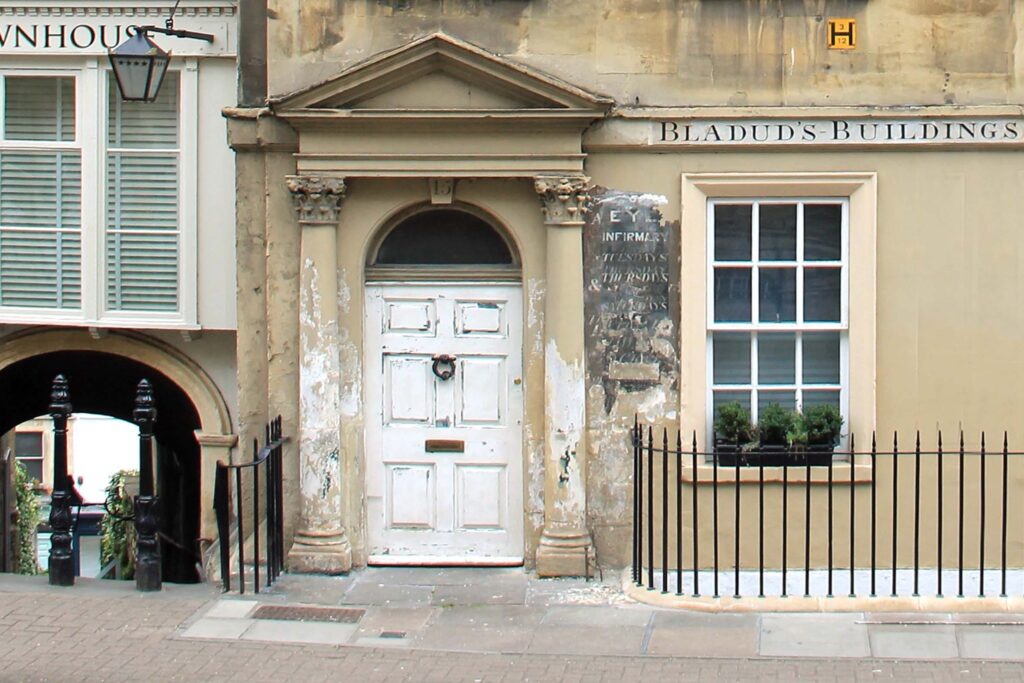
Thanks for a tip off from Philip Pope about this brilliant ghost sign that’s just been uncovered on 15 Bladud Buildings, which has prompted us to discover that this building has a really fascinating history. There’s not just one sign here – there are no less than three. The top one reads
EYE
INFIRMARY
TUESDAYS
THURSDAYS
and
SATURDAYS
From [?]
[?]
O’Clock
The sign underneath appears to be an earlier version of this, with similar wording. With the earliest sign, however, only its left and right-hand borders are visible, with a few letters just about visible on the left:
A––––––––––
––––––––––––
T–––––––––––
& –––––––––––
T––––––––––––
D––––––––––––
The first sign for the eye infirmary probably dates from 1847, when the Bath Eye Infirmary moved here from Pierrepont Street. The later sign cannot be dated so precisely but must date from before 1864, when the eye infirmary moved to 2 Belvedere. (It subsequently moved to 1 Belvedere, extended back into 2 Belvedere in 1909, and eventually closed in 1973.)

As regards occupants prior to 1847, the 1800 directory lists a Mrs Moore here, while the 1819 and 1826 directories list a Mrs Collins. It is likely that both were lodging house keepers, so it seems unlikely that either of them had a sign painted. In 1833, however, the occupant was William John Church, a surgeon and apothecary, and also a councillor. He seems the likeliest candidate for having the earlier sign painted – and perhaps the A was the start of the word APOTHECARY – but this can only be a guess. Mr Church remained at No 15 until the Eye Infirmary took over.
After the eye hospital moved out in 1864, the house had some illustrious occupants. At some point, Isaac Pitman mush have acquired it, for in 1871 he leased it to Maurice Batiste, a photographer from France, who had a studio here for the next ten years. By 1884 William Harbutt and his wife, both listed as professional artists, had taken up residence, remaining until at least 1895.
The building would return to medical uses, however. By 1902, the Misses Mclelland – ‘certified masseuses, chiropodists, manicurists, electricians, etc’ – had taken up residence. They were still here in 1921, but by 1927 a dentist called Frederick Howell had taken over. His stay was relatively brief, as by 1932 Miss Muriel Blackmore, photographer and antique dealer, had opened the ‘Gainsborough Studio’ here – the second photographic studio in the building’s history. She was here until the early 1960s, but by 1967 Alexander & Morris Ltd, design engineers – also known as G Alexander and Partners – had set up business here. They had also moved into 11 Bladud Buildings and had another office in Weymouth.
Quite a history – and now this distinguished building also has one of Bath’s oldest and most intriguing ghost signs – a window onto a forgotten past.